


Week 8 - Testing Lighting Setups - The Return of Marcus
- Roxana Baloiu
- Nov 1, 2022
- 3 min read

Updated: Nov 13, 2022
Hands-on Exercise - Film and Digital Camera
We didn't have a quiz this week! We went over the technical things we missed the previous week. And then we did some hands-on lighting setups. I was on the camera setup team this week.
Cross-Key Lighting Setup - by Marcus
We were trying to create cross-key lighting in a restaurant scene where the only motivated lighting is a candle on the table.
Key lights are crossed
Soft-fill needed (probably bounced)
Overhead pepper light to motivate the lighting coming from the candle
The Setup...
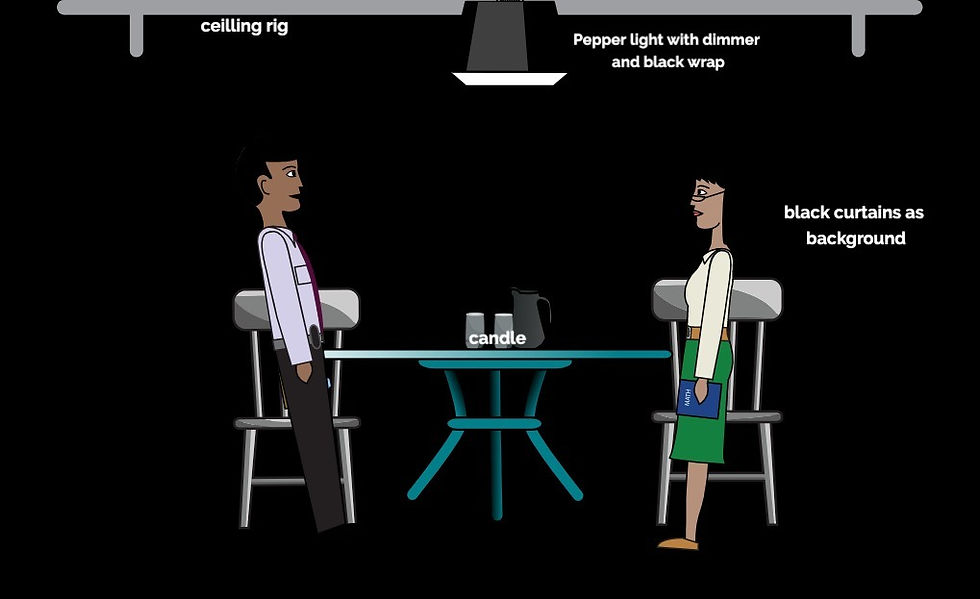
The frame, what the camera sees...

The overhead Setup...
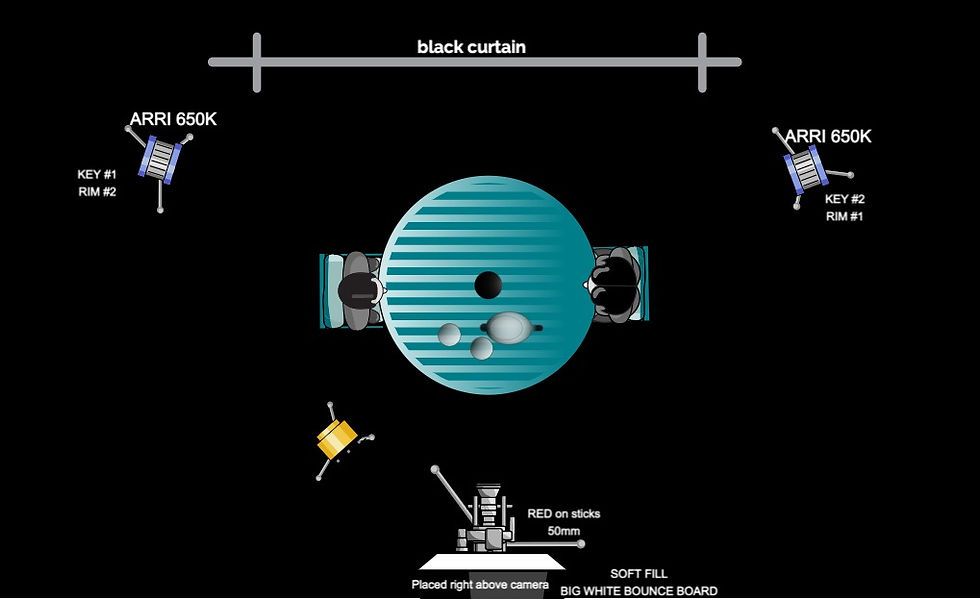
The 2 ARRI 650K lights acted as both Key for one subject and Backlight for the other. A bounce fill was added and held above the camera because the contrast ratio was too big. The bounce was a 4x4 white bounce. The light source was a 1K bounced in a U-shaped light pointed towards the 4x4 white bounce. We had to also add a grate to the light to cut it down a bit. This added extra fill light on both subjects.
The overhead pepper was rigged on the ceiling rig and wrapped with black wrap to create a very directional light source. It was also put on a dimmer to control the intensity of it.
A 2nd pepper was added and pointed towards the black curtain to give a bit of background texture.
The Result...

(This is photo of the tv screen and my phone cam takes really bad photos in low light but this give a bit of detail to what it looked like)


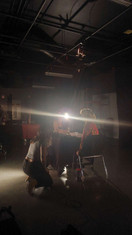


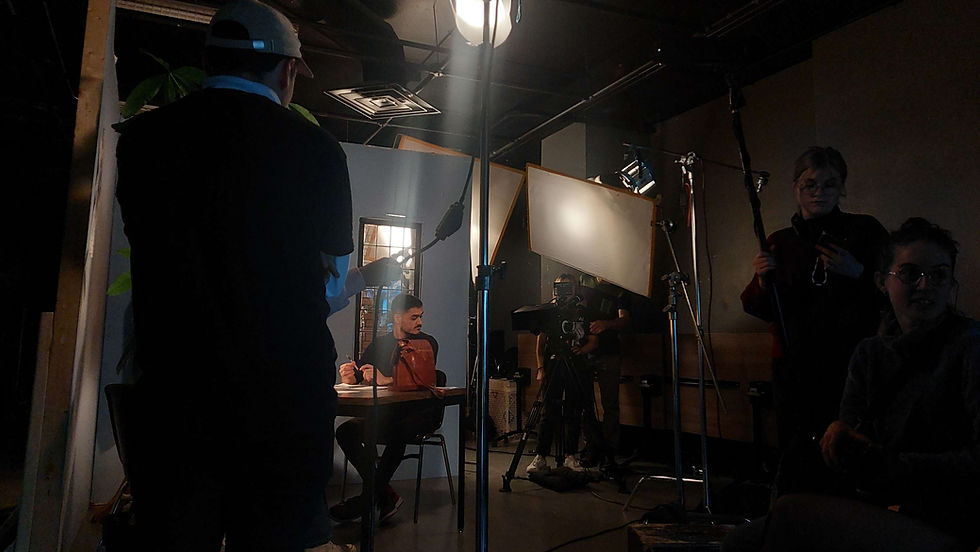
Behind the scenes of the day.
Jared's Lighting Setup
I was on art department for the most part of the exercise so I am missing some of the technical details of the setup.
The shot we were trying to recreate...

From the film Cure by Kiyoshi Kurosawa.
The Results...

How we recreated it
Camera
Red Camera on sticks with 50mm lens on it
Lighting
For the background...
- A practical on a dimmer, only it flickered a bit and had a tint to it
-Behind the fake wall, an ARRI 650K pointed at the wall and flagged with a black flag
in order to produce that light onto the "x"
For the middle and foreground
-a pepper light to give a little texture to the curtain background
-ARRI 650K bounced off of a 4X4 white bounce onto the wood wall
Art Department
We had to create 2 walls for this setup, one was a black curtain rigged on the ceiling rig
and the other was one of the wood walls available to us in the studio.
We got a practical from the editing suite to rig onto the desk in the background
We used tape to replicate the "x" on the wall.
We made both actors sit on black chairs
To lift the actors we put under their chairs 1/2 apple boxes
Behind the character in the foreground we added some apple boxes to recreate the clutter in
the original shot
The Overhead Plan

The Results...


Comments and Takeaways
Fun times with everyone. We found a giant lizard as a prop to use for Jared's setup. The energy in the class was nice and fun. It was a good experience. Liked the cross-key lighting effect, seems like an interesting trick to use on future shoots.
SOME THEORY EXPLAINED IN CLASS
Bit Depth
How many numbers are used to represent the colours when you sample colours digitally.
Usually 8,10,12 bit.

8bit + and 8 bit system with an alpha channel (represented by +) - has a capacity to generate 256 different shades of colour for each R,G,B.
10bit - capacity to generate 1024 shades.
Some digital cams can record 16-bit color (65,536 levels) or more
Because colour is produced by 3 different colour channels (RGB)
8-bit system can produce more than 16 million colors (256x256x256)
10-bit system can produce more than a billion colors
Recording with high bit depth can improve picture
But creates more data to process and store
Alexa and Red can record at 14bit.
Bayer Pattern
Used with CMOS sensor (sensors are B&W)

The sensor has a bayer filter that absorbs either the color information of Red, Green or Blue.
Debayering is the process in which the RAW file is translated into a viewable image.
RAW vs LOG vs REC.709

REC.709 vs REC.2020 Colour Space


Linear vs Log Curve

CODEC - COMPRESSION AND DECOMPRESSION
Software that compresses video then decompresses when you want to view it.
INTERFRAME COMPRESSION
Compresses in a frame, reduces information in that frame but keeps all the frames
High quality work, professional cameras
For acquisitions
INTRAFRAME COMPRESSION
Storing a group of picture as 1 keyframe
Between frames
Ex: mp4
Bad for editing
Used for distribution, even DCP (JPEG2000) uses Intraframe compression


Comments